

Is SuiteCommerce or Shopify Plus the best fit your business growth?
Choosing an eCommerce platform is not about themes. It is about orders, VAT, and data visibility.
This guide compares SuiteCommerce and Shopify Plus with a UK focus so you can make a confident, informed decision.
It draws on real numbers, credible benchmarks, and implementation data, not guesses.
Choosing The Right eCommerce Platform
- Pick SuiteCommerce if you run B2B eCommerce, need NetSuite ERP integration, and want real-time visibility across one platform.
- Pick Shopify Plus if you are early-stage, mainly B2C, and want to launch fast with a strong Shopify App Store ecosystem.
- Total cost evens out once you include connectors and third-party apps. SuiteCommerce removes those layers entirely.
The scale of both platforms
- Shopify powers 4 million+ merchants globally and dominates the UK B2C eCommerce market.
- NetSuite serves 40,000+ customers in 219 countries, with an estimated 4.3-9.3% global cloud ERP market share in 2025.
- NetSuite ERP is recognised as the top manufacturing ERP for UK businesses in 2025, supporting deep compliance and automation.
SuiteCommerce vs Shopify Plus – the UK VAT reality
VAT accuracy decides profit.
| VAT Scenario | SuiteCommerce Advanced | Shopify Plus |
| VAT on shipping | Built-in via NetSuite ERP | Manual rule or app |
| Multi-VAT across entities | Native configuration | Requires customisation |
| NI / EU distance selling | Fully supported | Limited; relies on the connector |
| VAT reporting | Real-time from the unified ledger | Split across systems |
When your ERP and eCommerce platforms are separate, reconciliation becomes a full-time job. SuiteCommerce integrates VAT, inventory, and finance natively; Shopify Plus depends on third-party integration for the same result.
B2B eCommerce: where SuiteCommerce leads

SuiteCommerce Advanced was designed for NetSuite users selling to B2B and B2C customers on the same site.
Its native credit control, quotes, and order hierarchy tools remove the need for app stacking.
Shopify Plus can mirror some of this through Wholesale Channel extensions, but costs rise quickly.
Implementation and customisation
- SuiteCommerce runs on HTML, CSS, and JavaScript, meaning any developer can customise without learning a proprietary language.
Upgrades include version locking, so custom work stays intact. - Shopify Plus uses Liquid, Shopify’s template language. It is powerful but limits flexibility and lacks version control.
SuiteCommerce suits teams planning structured, scalable deployments (typically three to six months for ERP rollout). Shopify Plus is faster to launch but harder to evolve once complex logic enters play.
Integration with NetSuite ERP
Integration defines whether you scale smoothly or drown in spreadsheets.
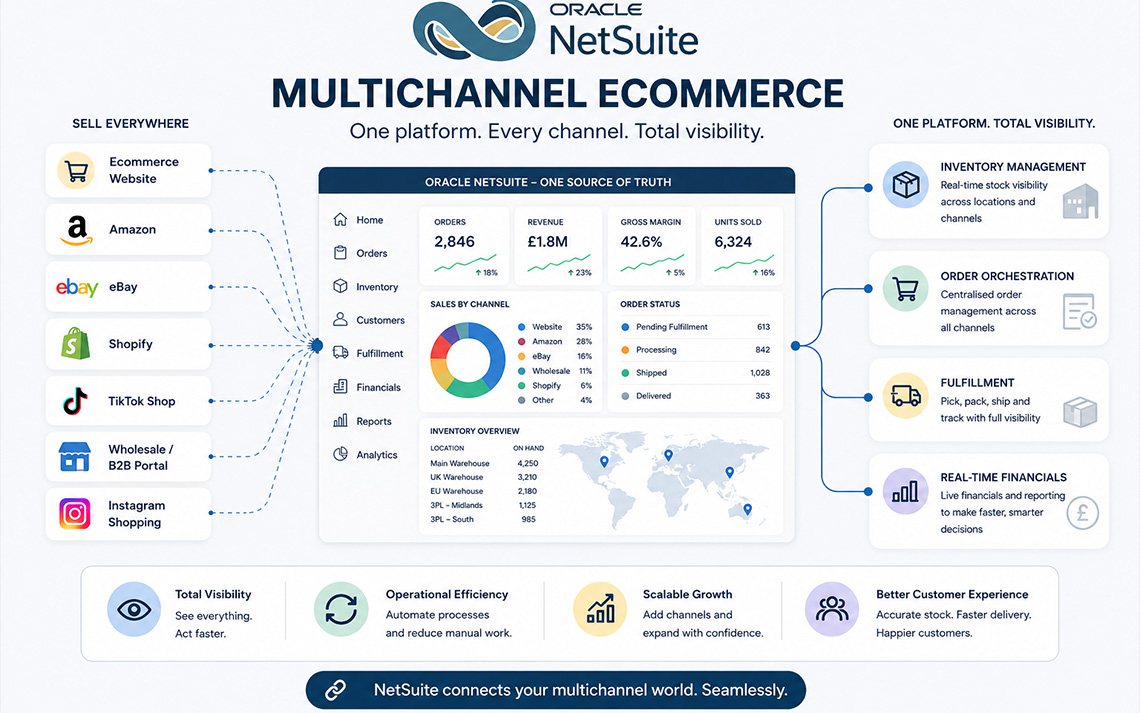
- SuiteCommerce Advanced and NetSuite ERP share one database.
Orders, stock, and financials update in real time with no connector needed. - Shopify Plus relies on connectors like Celigo or Boomi, costing £3,200 – £4,800 per year, and each sync adds latency and maintenance risk .
Web-store functionality and scalability
Both use global content delivery networks (Cloudflare for SuiteCommerce; Fastly for Shopify) for performance.
Both can scale traffic. The difference is functionality depth.
| Capability | SuiteCommerce | Shopify Plus |
| Faceted navigation | Native | App required |
| Merchandising zones | Yes, from ERP data | No native support |
| Multi-warehouse stock | Real-time | Limited |
| Multi-currency / language | Unlimited | Up to 9 currencies; cloned sites for languages |
When you add more warehouses, markets, or currencies, SuiteCommerce scales natively.
Shopify Plus handles traffic, not operations.
Design flexibility and add-ons
- Shopify Plus has more themes and a faster visual setup.
- SuiteCommerce Advanced offers fewer themes but full access to the source code, giving complete control over structure, SEO, and branding.
Both support third-party apps, but SuiteCommerce avoids the heavy plugin chain that often complicates Shopify Plus upgrades.
Cost comparison for UK mid-market retailers

Shopify Plus looks cheaper up front. Over three years, SuiteCommerce Advanced usually matches or beats it once you remove the connector and app fees.
Practical scenarios
Choose Shopify Plus if you:
- Operate primarily B2C, and speed to market outweighs system depth.
- Have a turnover below £2 million and can manage 5–10 apps.
Choose SuiteCommerce if you:
- Already use NetSuite ERP.
- Need ERP integration, B2B features, or multi-warehouse order management.
- Want to avoid technical debt from connectors.
SuiteCommerce vs Shopify Plus – quick reference table
| Feature | SuiteCommerce Advanced | Shopify Plus |
| ERP Integration | Native with NetSuite ERP | Third-party connector |
| B2B Features | Rich, native (credit terms, quotes, price lists) | Apps for advanced features |
| VAT / Compliance | Fully built-in | Add-ons / manual setup |
| Build Cost | £32 000 – £64 000 | £48 000 – £160 000 |
| Licence Fee | £35 000 – £50 000 (discounted) | £19 200 – £24 000 |
| Implementation Time | 3 – 6 months | 4 – 8 weeks |
FAQs
Is SuiteCommerce better for UK VAT?
Yes. VAT on shipping, multi-entity, and distance-selling rules are built into NetSuite ERP, with native reporting.
Can Shopify Plus handle B2B?
Yes, but complex B2B setups need multiple apps and custom logic .
Which platform is more scalable?
Both scale traffic. SuiteCommerce scales operations through unified ERP integration.
Can I start on Shopify and move later?
Yes. Many brands run Shopify integrated with NetSuite first, then switch to SuiteCommerce when complexity rises.
Final word from Cofficient
Cofficient helps UK retailers and distributors get control of their operations.
We implement NetSuite ERP and SuiteCommerce so businesses can grow without adding more systems.
If you want to see the real cost and effort behind Shopify vs SuiteCommerce, we will map your orders, VAT, and integrations, no jargon, just facts.
Contact us to review your current setup and plan the next step.