


Every return costs more than postage. It costs time, loyalty, and future sales. For eCommerce businesses, the real challenge is not returns themselves, but what causes them. Incorrect shipments, poor stock visibility, and disconnected data often lead to unnecessary refunds.
With a more effective order management system, these mistakes can be avoided. Accurate inventory management and connected processes help you reduce returns, protect margins, and deliver a smoother customer experience.
The Real Cost of eCommerce Returns – Benefits of an Order Management System (OMS)
According to (eCommerce News 2025), UK eCommerce return rates now sit at around 17.5%, the highest in Europe and significantly above the United States, where rates average 11%. For every pound returned, 78% is refunded rather than exchanged, meaning most lost revenue never comes back.
The average cost of processing a single return in the UK is £13.10 once packaging, restocking, labour, and logistics are considered. For large online retailers, returns account for up to 14% of total operational costs.
When you multiply that across thousands of transactions, the financial impact becomes hard to ignore. But it is not only about the cost of postage and packaging. Returns often expose deeper problems, poor stock visibility, delayed order updates, and systems that cannot manage workflows efficiently across multiple channels.
Retailers that have adopted the right order management solution have found measurable improvements. (Grand View Research 2023 – 2030) reports that companies integrating inventory management software with their eCommerce systems reduce return rates by up to 30% while improving profit margins by 25%.
Why Inventory Accuracy Matters to Streamline and Process Orders
Many businesses assume returns are driven by buyer behaviour, wrong sizes, impulse purchases, or indecision. In truth, 30% of eCommerce returns are caused by inventory and fulfilment errors. Wrong items shipped, inaccurate descriptions, and out-of-stock replacements damage confidence and force customers to look elsewhere.
Retailers with 95% or higher inventory accuracy achieve up to three times higher satisfaction scores. The connection between stock accuracy and customer experience is direct. When products arrive correctly and on time, trust grows, and with it, retention.
Inventory accuracy also improves operational visibility. With real-time updates across systems, staff know exactly what is in stock, what is reserved, and what is on order. That reduces duplicate orders and prevents cancelled sales caused by stockouts.
Accurate inventory data does more than improve fulfilment; it prevents costly mistakes that undermine both profitability and reputation.
How an Effective Order Management Solution Prevents Returns
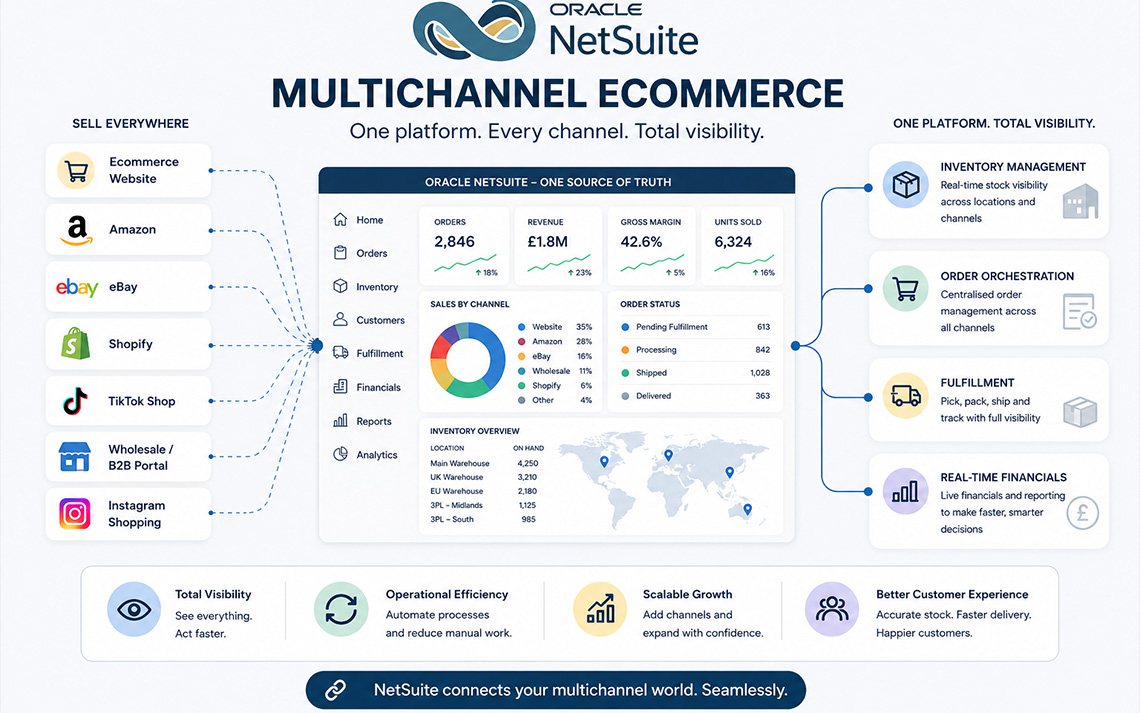
A connected order management system (OMS) is the backbone of efficient eCommerce. It brings every stage of the order fulfilment process, sales, stock, accounting, and delivery, into one environment.
When eCommerce, warehouse, and finance systems operate separately, errors multiply. Orders are entered twice, information goes missing, and delivery updates lag behind reality. Customers end up receiving wrong or delayed shipments.
An effective order management software platform centralises data so you can process orders accurately and quickly. It enables:
- Real-time inventory updates across every sales channel.
- Automated order routing to the correct warehouse or store.
- Live status tracking for customers and service teams.
- Instant communication between the warehouse and finance teams.
This automation removes the friction that causes many avoidable returns. According to (Acctivate 2025), companies using integrated OMS platforms report 35% fewer fulfilment errors and 40% faster processing times.
When returns do happen, connected systems simplify the reverse logistics workflow. Refunds are processed automatically, stock levels adjust instantly, and replacement orders can be shipped the same day. That turns a potential negative interaction into a reliable customer service moment.
Improving the Customer Experience Through an Order Management System
In eCommerce, the returns process is an extension of your customer service. Shoppers judge you not only by how quickly you deliver, but also by how easily they can return an item.
Disjointed systems make returns painful, customers wait days for confirmation or chase updates from multiple departments. With the right order management solution, that frustration disappears.
Centralised data allows customer-service teams to view every order in one dashboard. They can see the product status, shipment tracking, and refund progress instantly. No guesswork. No delays.
Transparent communication builds confidence. When customers receive accurate updates, they trust your brand. And when they trust you, they buy again.
Retailers with connected order management systems report higher Net Promoter Scores (NPS) and stronger repeat purchase rates. The correlation is simple: efficient fulfilment and visibility drive satisfaction.
Visibility Across Multiple Channels Through Order Management Software
Modern eCommerce rarely runs on a single sales channel. Orders come from websites, marketplaces, and in some cases, physical stores. Without a unified order management system, tracking those orders consistently becomes impossible.
A connected OMS platform offers complete visibility across multiple channels. Whether the sale comes from Amazon, eBay, or your own eCommerce site, data flows into one central system.
That visibility helps you avoid overselling and stock duplication. It also ensures customers receive accurate delivery promises regardless of where they purchased.
Having a single view of stock and order data gives operations teams the confidence to process orders faster, while finance teams can forecast demand more precisely.
The result is a consistent customer experience, every time, across every channel.
Automation and Workflow Efficiency to Deal with Orders Quickly and Efficiently
Automation is more than convenience. It is a safeguard for your reputation and profitability.
An automated order management software system manages workflows from order to delivery. When an order is placed, the system automatically verifies payment, checks stock availability, and assigns fulfilment locations.
If an item is out of stock, automated workflows can route the order to another warehouse or initiate backorder notifications. Each stage happens in real time, without manual input.
Automation also extends to the returns process. Refunds, exchanges, and restocks are handled automatically. This reduces handling time, eliminates duplicate data entry, and ensures accuracy.
According to (SearchHog 2025), retailers using automation within their order management systems reduce operational costs by 40% and improve refund speed by 30%.
That speed improves the customer experience, cuts admin costs, and gives staff time to focus on higher-value tasks.
Profitability Through Better Inventory and Order Management
Reducing returns is not just about improving operations; it is about protecting profit.
Every product returned ties up working capital until it can be resold or written off. Reducing return rates from 17% to 12% can release thousands of pounds in inventory value each month, money that can be reinvested into marketing, staff, or new product lines.
With accurate inventory management and real-time order visibility, finance teams can forecast cash flow with more confidence. This helps prevent overspending on stock and reduces waste.
Inventory accuracy also reduces write-offs. When every item is traceable from supplier to customer, there are fewer discrepancies and less shrinkage. That level of precision translates directly into better margins.
The most profitable eCommerce companies are those that understand this link: operational accuracy equals financial performance.
The Growing Importance of Connected Systems
The UK eCommerce sector now represents 27.6% of total retail sales (ONS, 2025). With that growth comes complexity. Businesses are processing higher order volumes, managing more SKUs, and competing on delivery speed as much as price.
At the same time, compliance requirements such as HMRC’s Making Tax Digital rules are pushing companies toward integrated, cloud-based systems. According to Retail Insight (2025), 65% of UK retailers are implementing cloud ERP or accounting solutions to handle this shift.
Integrated technology gives businesses the agility to manage demand, improve visibility, and make faster, data-backed decisions. In a competitive market, that agility is the difference between scaling and stalling.
Choosing the Right OMS
Selecting the right order management software is not about features; it is about fit. The best systems bring together eCommerce, warehouse, and financial processes under one roof.
When evaluating OMS platforms, consider:
- Real-time inventory visibility and automation.
- Integration with eCommerce and accounting systems.
- Ease of use for warehouse and customer service teams.
- Scalability across multiple channels and regions.
Businesses that implement connected order management solutions gain measurable improvements across accuracy, fulfilment speed, and profitability.
At Cofficient, we help companies identify, configure, and deploy systems that meet these exact needs.
How Cofficient Helps eCommerce Businesses Take Control
Cofficient works with growing retailers and wholesalers that want more control over their operations. We get under the skin of your business, understand where inefficiencies lie, and deliver systems that remove them.
Our focus is not just on technology, it is on outcomes. Better visibility, faster fulfilment, and fewer returns mean stronger customer relationships and healthier profit margins.
We implement solutions that connect ecommerce, inventory, finance, and customer management into one system so you can process orders accurately and maintain real-time visibility across every stage of the customer journey.
With the right setup, your team can process orders efficiently, manage stock precisely, and deliver every order correctly, the first time.
The NetSuite SuiteCommerce Software Solution
Among the solutions Cofficient provides, NetSuite SuiteCommerce stands out for its ability to unify eCommerce, inventory, and financial operations in one integrated system.
SuiteCommerce connects every part of the eCommerce lifecycle, from online storefronts and order processing to warehouse management and financial reconciliation.
It delivers:
- Real-time visibility into inventory and sales.
- Automated order fulfilment workflows to reduce human error.
- Centralised data across multiple channels.
- Built-in reporting for better financial control.
When implemented by Cofficient, SuiteCommerce becomes more than software — it becomes a system for precision.
That precision helps businesses cut return rates, improve customer satisfaction, and grow sustainably without adding operational complexity.
Final Word
High return rates are not an unavoidable part of eCommerce. They are a symptom of poor visibility and disconnected systems.
By improving inventory management and implementing an effective order management system, retailers can cut return rates, improve cash flow, and deliver a better experience for their customers.
Cofficient helps you take control of your data, processes, and performance, giving you the clarity and accuracy needed to make every order count.