

A Practical Guide for UK Retailers and Wholesalers
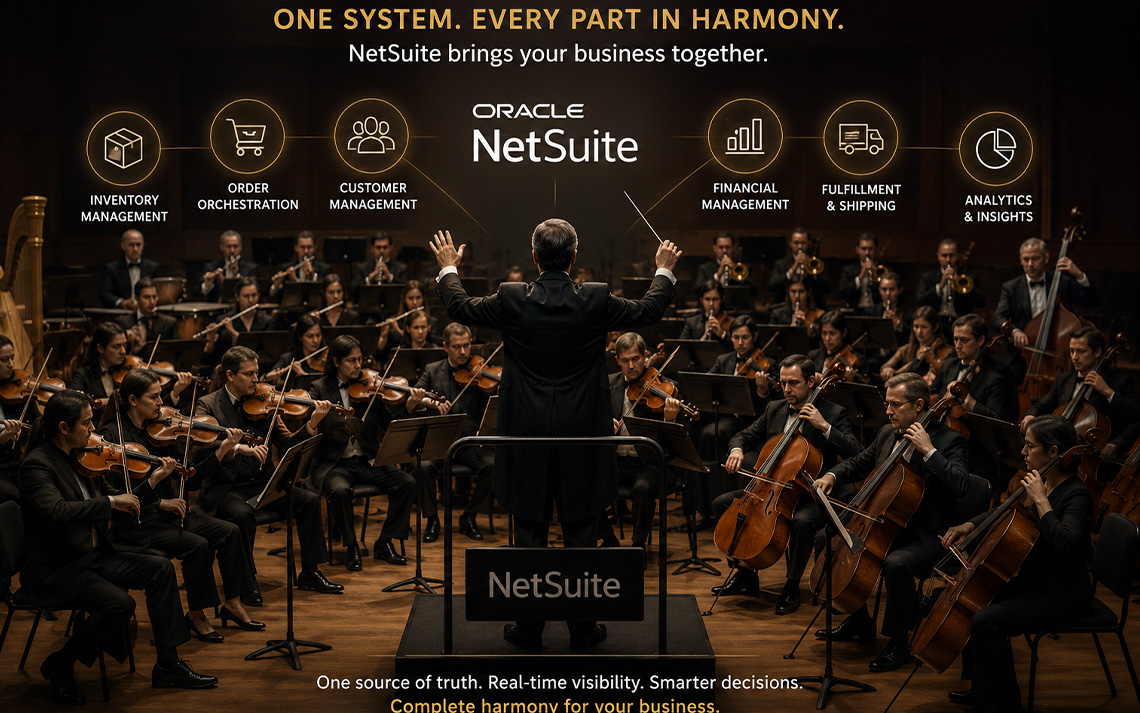
Running multi channel ecommerce today can feel like trying to conduct an orchestra where every musician is reading a different sheet of music.
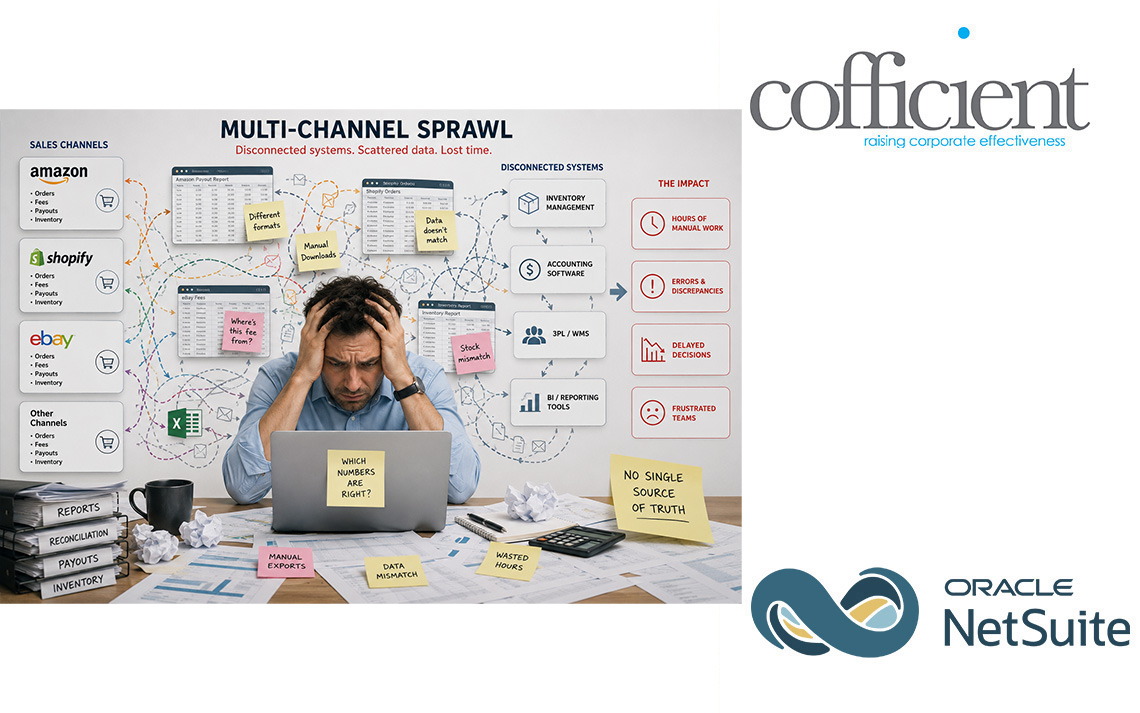
Your website has one view of inventory. Marketplaces have another. Finance is working from spreadsheets. Warehouse teams are reacting to orders that arrived three systems ago. Somewhere in the middle, customer service is trying to explain why an item that showed as “in stock” has vanished into the digital fog.
For UK retailers and wholesalers, growth often creates complexity before it creates simplicity.
This is where NetSuite can change the picture.
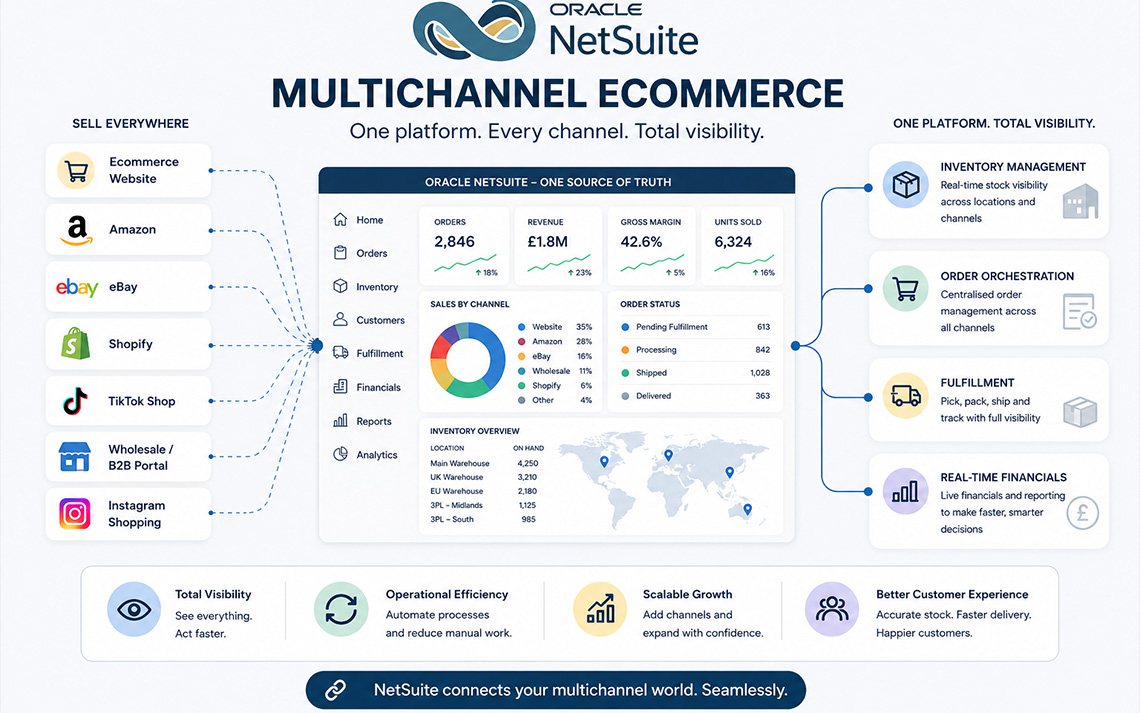
Rather than adding another disconnected platform into the stack, NetSuite combines ecommerce, inventory, orders, financials and operational processes into a single connected system.
Here’s a practical look at how it helps ecommerce businesses operate more effectively.
Inventory management without the guesswork
Inventory accuracy becomes increasingly difficult when selling across multiple channels.
Retailers and wholesalers are often juggling:
- Ecommerce websites
- Amazon and marketplace sales
- Wholesale orders
- Multiple warehouses
- Physical stores or locations
- Third-party logistics providers
Without a central source of truth, inventory discrepancies can quickly appear:
- Overselling products
- Stockouts
- Excess inventory
- Manual reconciliation work
- Delayed fulfilment
NetSuite provides real-time inventory visibility across the business.
Instead of teams checking multiple systems, inventory information updates centrally and becomes visible across all channels.
This allows businesses to:
✔ View stock levels across locations
✔ Set reorder points and replenishment rules
✔ Reduce manual inventory adjustments
✔ Improve fulfilment accuracy
✔ Make faster purchasing decisions
The result is less time spent searching for answers and more time acting on them.
Order orchestration across every sales channel
Customers rarely buy through a single route anymore.
An ecommerce business might receive orders from:
- Its own website
- Amazon
- eBay
- Wholesale customers
- B2B portals
- Social commerce channels
The challenge isn’t taking orders.
The challenge is coordinating them.
NetSuite helps orchestrate order management across channels by automatically routing orders through fulfilment workflows and giving teams visibility from order placement through to delivery.
This helps businesses:
- Prioritise and allocate inventory
- Reduce manual processing
- Improve fulfilment speed
- Handle exceptions more effectively
- Deliver a more consistent customer experience
Instead of multiple systems passing messages like a relay race, information moves through a connected workflow.
Real-time financials for faster decisions
Many growing ecommerce businesses discover that financial reporting starts lagging behind operational activity.
By the time reports are assembled:
- Margins may already have changed
- Stock costs may have shifted
- Sales trends may have evolved
- Teams are making decisions based on yesterday’s information
NetSuite connects operational activity directly to financial reporting.
That means orders, inventory movements and purchasing activity flow into financial processes automatically.
Businesses gain access to:
- Real-time revenue visibility
- Margin reporting
- Cash flow insights
- Sales performance dashboards
- Faster month-end processes
When financial information updates continuously, decisions become less reactive and more informed.
Connecting marketplaces with ChannelUnity and Cofficient
For many ecommerce businesses, marketplaces represent a major revenue opportunity.
But managing them manually creates complexity quickly.
Marketplace teams often face:
- Separate stock updates
- Different order processes
- Duplicate data entry
- Increased risk of errors
At Cofficient, our partnership with ChannelUnity helps bridge this gap.
ChannelUnity connects NetSuite with leading marketplaces and ecommerce channels, allowing inventory, pricing and orders to synchronise automatically.
This creates a more connected ecosystem where businesses can:
- Expand into new channels
- Reduce manual administration
- Maintain inventory accuracy
- Improve operational efficiency
Instead of adding complexity as channels grow, businesses can scale with greater control.
Real-world example: Ooni
A strong example of scaling ecommerce operations is Ooni.
As ecommerce growth accelerates, businesses often need stronger visibility and operational control across inventory, fulfilment and customer demand.
Ooni’s growth journey highlights a challenge many businesses recognise:
How do you continue delivering excellent customer experiences when order volumes, channels and operational demands keep increasing?
Connected systems become increasingly important as scale grows.
Bringing everything together
Ecommerce success isn’t only about selling products online.
It’s about creating a connected operation behind the scenes.
When inventory, orders, marketplaces and financials operate in separate silos, friction appears everywhere.
NetSuite helps create a single environment where teams can work from shared, real-time information.
The result:
- Better visibility
- Reduced manual effort
- Faster fulfilment
- Improved customer experiences
- Stronger foundations for growth
Download the Ecommerce Datasheet
Want a deeper look at how NetSuite supports ecommerce retailers and wholesalers?
Download our Ecommerce Datasheet to explore the features, integrations and capabilities in more detail.