


10 Most Common eCommerce Challenges Facing the eCommerce Industry – And How to Overcome Them
eCommerce is no longer just a sales channel. For CFOs in 2025, it is a strategic battleground, one that affects gross margin, cash flow, and working capital daily. As businesses grow, so do the cracks in their systems, which can negatively impact customer experience. Here are ten financially significant challenges every CFO needs to watch.
How Rising Customer Expectations Are Creating New eCommerce Challenges for Retailers
Today’s customer wants fast, flawless, and flexible fulfilment, without paying more for it. According to (PwC 2025), 90% of shoppers expect delivery in under three days, with nearly a third expecting same-day. These demands hit operations hard. For finance teams, that means rising shipping costs, increasing return volumes, and tighter gross margins. Without fulfilment efficiency, costs escalate fast. The solution is not just to spend more, but to spend smartly, and that starts with connected systems that cut waste across logistics, inventory, and customer service.
How Poor eCommerce Website Experiences and Checkout Challenges Are Costing Retailers Revenue
Most finance leaders do not see it, but a poor checkout experience is a leak in the profit pipe. The (Baymard Institute 2025) reports that the average cart abandonment rate is over 70%. The cause? Friction. From limited payment options to confusing pricing or long load times, shoppers are bailing before they buy. Every one of those lost conversions is missed revenue and a hit to customer satisfaction. For CFOs, the lesson is clear: platform experience directly impacts sales performance. Integrated platforms with seamless checkout processes convert more browsers into buyers, and that shows up directly in the P&L.
Why eCommerce Return Challenges Are Costing Retailers Margin and Customer Loyalty
Returns are not just an inconvenience; they are a cost centre. In 2023, the (NRF 2023) found that returns cost U.S. retailers $743 billion, with an average return rate of 16.5% across online sales. Behind every return is a set of hidden costs: restocking, shipping, inspection, repackaging and often, disposal. CFOs focused on margin need to treat returns as a financial priority, not just a warehouse problem, to improve the shopping experience. Reducing returns even slightly has a massive impact. Better product data, real-time stock accuracy, and smarter fulfilment flows all reduce error rates , and with them, the erosion of margin.
Why Manual Processes Remain One of the Biggest eCommerce Challenges Facing Retailers
Manual stock tracking, reconciliations, spreadsheet reporting, it all adds up. Finance teams stuck in reactive mode are unable to provide strategic insight or move at speed. Worse, bad data leads to bad decisions. (Gartner 2025) reports that poor data quality costs businesses up to 20% of their margin. For CFOs, that is not acceptable. Automating routine finance tasks frees up resources, improves accuracy, and shortens time-to-close. But to do that, systems need to be integrated, not stitched together with plugins and API patches.
Inventory Inaccuracy Locks Up Working Capital with Fulfilment Challenges
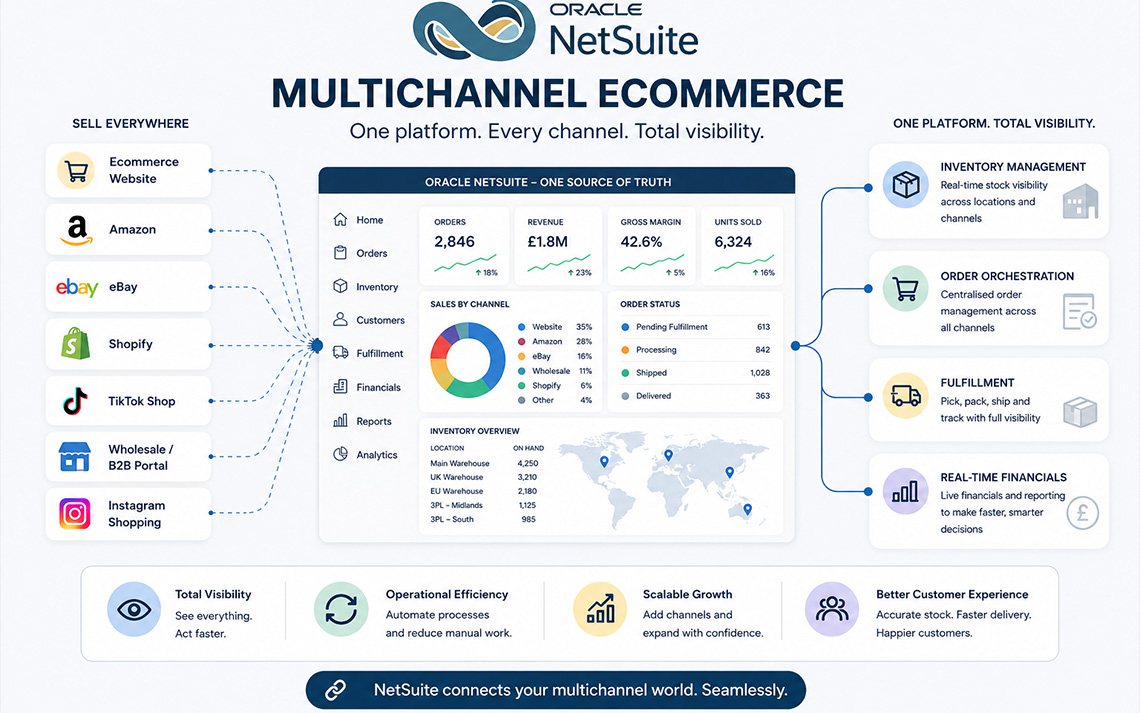
Without real-time visibility, inventory becomes a black hole for cash. Products sit idle in warehouses. Bestsellers go out of stock. Overstock gets discounted. For a finance leader, this is not an operations issue, it is a working capital problem. Tied-up cash restricts investment, slows agility, and increases risk. Integrated ERP platforms like NetSuite improve inventory accuracy by up to 35% (ProjectSalsa, 2023). That means better forecasting, faster turns, and more capital released back into the business.
Disconnected Systems Obscure Cash Flow
Cash is not just king, it is visibility. When eCommerce platforms, ERPs, and fulfilment systems do not speak to each other, finance teams are stuck reconciling reports, chasing numbers, and operating on lagging data. Only 2% of CFOs say they trust their company’s real-time cash flow data, according to (Upland Software 2025). That lack of trust leads to slow decisions, poor forecasting, and avoidable risk. Fully integrated platforms give finance one source of truth, and the clarity needed to act decisively.
Patchwork Tech Stacks Are a Margin Killer
Most growing eCommerce businesses are running on fragile tech stacks: Shopify for sales, QuickBooks for finance, a WMS add-on, and spreadsheets in between. This works up to a point. But once scale kicks in, it falls apart. Syncing fails. Data duplicates. Reporting lags. It is operational drag and it hits the margin hard. CFOs should be thinking long-term infrastructure to streamline operations, not short-term patches. Unified commerce and finance systems remove friction and protect profitability at scale.
Omnichannel Complexity Increases Risk and Reduces Customer Engagement
Customers do not care about your backend, they expect a joined-up experience. Yet a small portion of retailers have true omnichannel capability, despite shoppers expecting it. For CFOs, that creates hidden risk. Orders placed online cannot be returned in-store. Stock visibility lags across channels. Support teams waste hours resolving simple problems. Leading to lost loyalty, higher service costs, and damaged reputation, all with financial consequences.
Bad Data Is Undermining Forecast Accuracy and Customer Support
Forecasting only works if the data does. And most of it does not. Whether it is inaccurate stock levels, delayed sales reports, or disconnected systems, the result is the same, finance teams make partial decisions with partial data. According to (FTI Consulting Survey 2025), 47% of CFOs are increasing investment in data quality and predictive analytics. But the tools only work when systems are joined up. It is not enough to buy dashboards. You need clean, real-time, integrated data underneath them.
Scaling Without Integration Increases Compliance Risk for Online Retailers
Growth sounds good, until you outgrow your systems. As SKUs multiply, suppliers expand, and jurisdictions widen, compliance becomes increasingly challenging. ESG, VAT, customs, multi-entity consolidation, it all piles onto finance. If your systems cannot keep up, you risk missed deadlines, audit flags, and regulatory fines. NetSuite and SuiteCommerce are built for this world, multi-currency, multi-country, multi-channel, without the manual workarounds.
The Cost if you do not overcome challenges in eCommerce
CFOs in 2025 are being asked to do more than ever: control costs, accelerate growth, manage risk, and deliver faster insight. But the tools most teams rely on to streamline their supply chain are holding them back. Legacy systems, disconnected platforms, and manual workarounds are not just inefficient, they are expensive.
At Cofficient, we help you take control of your inventory, your reporting, and your margin. By implementing SuiteCommerce Advanced and NetSuite together, we bring your finance and commerce into one integrated platform, built to scale, and built for CFOs.
Get in touch today!