


NetSuite SuiteCommerce vs Shopify Plus
CFOs do not buy websites. You buy financial control, accurate reporting, and predictable cost of ownership.
Two platforms dominate the conversation at the board level:
- NetSuite SuiteCommerce: an ERP-driven eCommerce platform built into a full cloud ERP.
- Shopify Plus: a standalone eCommerce solution with a strong storefront and app ecosystem.
Both claim to be the best eCommerce platform for growing businesses. But which actually delivers the financial clarity and control CFOs need?
ERP-Driven vs Standalone eCommerce Platform: Which is the Best eCommerce Solution for Your Business in 2025?
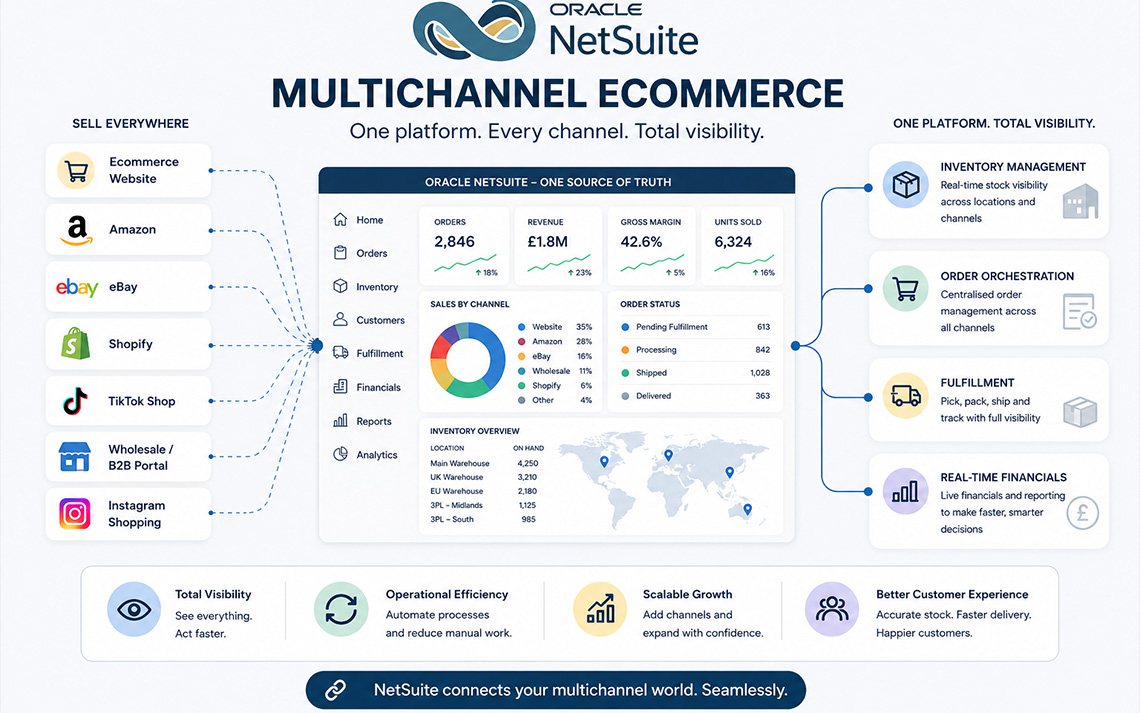
SuiteCommerce is not just another eCommerce website builder. It is part of NetSuite ERP, which connects finance, CRM, inventory, and order management in a single cloud system. Every sale, return, and tax entry is automatically updated in real-time financials.
Shopify Plus, by contrast, is a market-leading eCommerce site solution that works best as a storefront. Finance and ERP integration usually relies on third-party connectors, which means extra contracts, support hours, and risk.
For finance leaders, this difference in architecture drives everything from reporting speed to total cost of ownership.
Financial Reporting in eCommerce: Why the Best eCommerce Platform in 2025 Must Deliver Real-Time Data and Business Needs
SuiteCommerce provides finance teams with live dashboards for revenue, margins, and cash flow, eliminating the need for exports or manual reconciliation. You can consolidate across multiple entities, stay compliant across regions, and manage tax and fulfilment in one place (Oracle NetSuite 2025).
Shopify Plus reporting works well for trade data, but P&L and cash visibility usually depend on separate finance tools or spreadsheets. That delay matters. Real-time ERP eCommerce reporting reduces manual entry, cuts errors, and gives CFOs the numbers they need when they need them (Versa Cloud ERP 2024).
Total Cost of Ownership for an eCommerce Website: Platforms to Consider from Shopify to eCommerce Software and Website Builder Options
At first glance, Shopify Plus looks cheaper. Subscription fees start from around $24,000 per year (Vervaunt 2024), which feels manageable for many finance teams. But that is only the beginning. Apps for catalogue management, connectors for finance, custom payment setups, and headless builds can quickly inflate spend. Independent comparisons show that the total cost of ownership can rise by as much as 35% once you add in integration and operational overheads. (Shopify 2024).
SuiteCommerce costs more upfront, but comes with fewer moving parts. Catalogue, orders, tax, finance, and reporting are all native. You are not paying for dozens of separate apps or fighting with incompatible contracts. Oracle highlights that SuiteCommerce reduces integration spend and removes manual effort tied to disconnected systems. (Oracle NetSuite 2025).
For CFOs, the conclusion is simple: if you are multichannel, multi-entity, or scaling quickly, an ERP-driven eCommerce solution offers more predictable costs and fewer financial surprises over the lifecycle.
Best eCommerce Website Builders and Integrations: Platforms to Consider When Choosing an Online Store Solution
Integration is not a one-time job. It is a permanent cost centre. Every extra connector increases latency, overhead, and risk.
SuiteCommerce sidesteps this problem. Orders, returns, pricing, and tax are native to NetSuite ERP, which removes the need for nightly syncs or duplicate ledgers. Finance teams spend less time on reconciliation, and IT spend on “keeping the pipes flowing” drops. Implementation partners also highlight SuiteCommerce’s native order management and promotions as proven drivers of revenue without app sprawl (Jobin & Jismi 2025).
Shopify Plus can integrate well, but every connection adds a bill and another dependency. As your operation grows, so does the hidden spend required to keep systems talking to each other.
Choose the Best eCommerce Features: Scalability, Governance, and eCommerce Functionality
SuiteCommerce is built for complex business models. It supports both B2B and B2C, multiple pricing tiers, account credit, and multi-entity tax. It offers global consolidation, audit trails, and compliance features that align with CFO software standards. In its 2025 releases, NetSuite has even added AI-powered planning and analytics to help finance leaders forecast and control spend (Coderapper 2025).
Shopify Plus excels in direct-to-consumer. It is fast, flexible, and a popular choice among small businesses and enterprise retailers, supported by a massive app marketplace. That flexibility is attractive, but it also means managing more vendors and having less control over long-term governance.
For CFOs, SuiteCommerce offers a controlled, scalable environment with financial oversight at the core. Shopify Plus offers speed and agility, but with less predictability on cost and compliance.
| Area | SuiteCommerce (ERP-driven eCommerce platform) | Shopify Plus (standalone eCommerce) |
| Core model | Native to NetSuite ERP (single data model) | Storefront + apps + connectors |
| Financial reporting | Real-time, consolidated, audit-ready | Strong trade reports; finance is usually external |
| Multi-entity & compliance | Built-in consolidation, global tax | Achieved via apps/integrations |
| Fulfilment | Buy-anywhere, fulfil-anywhere in one system | Multi-location via apps/connectors |
| TCO | Higher licence, lower integration/ops | Lower entry; TCO rises with customisation |
| Speed to trade | Fast once ERP is in place | Very fast for storefronts |
| Best fit | Complex B2B/B2C, multi-company, global | Fast-moving retail, app-driven features |
The CFO’s Decision: Choosing an eCommerce Platform for Small Business or Enterprise and Finding the Best eCommerce Software in 2025
Shopify Plus is a strong contender if you need to launch an online store quickly and are prepared to manage finances separately. It is proven, with more than 50,000 enterprise sites running globally (DemandSage, 2025).
SuiteCommerce, on the other hand, is about more than trading online. It gives you financial control, real-time visibility, and a single version of the truth. Businesses using SuiteCommerce report up to 30% higher conversion rates thanks to faster, more accurate order management, and up to 70% improvement in return visitor rates when implemented strategically (Jobin & Jismi, 2025).
For CFOs, that translates into measurable ROI and a tighter grip on financial performance.
The Cofficient View
The platform you choose should deliver financial clarity, not just eCommerce functionality. If you need speed and agility, Shopify Plus is a safe bet. If you want one set of numbers, tighter controls, and lower integration risk, NetSuite SuiteCommerce is built for CFOs.
Cofficient has been implementing NetSuite across industries for years. We get under the skin of your business, and we deliver real outcomes: more control, more time, more sales, more insight.